Central African Republic (CAR) Waste Incinerator Market Research Report (2025)
1) Country context and why incineration matters in CAR
The Central African Republic (CAR) faces a waste-management reality shaped by three overlapping factors: fragile infrastructure, humanitarian operations, and public-health risk. In Bangui, daily municipal waste pressure is visible in collection gaps and informal disposal patterns, while outside the capital—cities like Berbérati, Bambari, Bossangoa, Bria, and Carnot—logistics, security constraints, and limited engineered facilities push institutions toward on-site treatment solutions.
In this setting, waste incinerators are not “nice-to-have” equipment; they are often the most practical way to reduce infectious medical waste, manage mixed camp waste, and prevent open dumping and uncontrolled burning—especially where transport to compliant landfills is inconsistent.
2) Market structure: who buys incinerators in CAR
CAR’s incinerator demand is typically project-driven rather than purely commercial. Buyers cluster into five groups:
-
UN missions and peacekeeping logistics: The UN stabilization mission MINUSCA operates multiple sites where controlled disposal of solid and biomedical waste becomes a continuous operational need, including remote bases and contingents. Recent UN reporting references MINUSCA distributing portable incinerators to reduce disposal risks at remote bases, highlighting that incineration is part of field operations, not a theoretical plan.
-
UN agencies / humanitarian operators: UNDP, UNICEF, WHO, WFP, OCHA partners, and major NGOs often procure waste solutions as part of health-system support, camp management, IPC (infection prevention and control), and emergency response logistics.
-
Hospitals and health centers: Infection control and safe handling of sharps/biomedical waste drive interest in medical waste incinerators, especially where compliant off-site treatment is limited. World Bank project documentation has explicitly noted that facilities meeting WHO-aligned disposal needs (including incineration) are limited, increasing risk of improper elimination of biomedical waste. (World Bank)
-
Municipal/urban sanitation programs: In Greater Bangui, sanitation and waste service upgrades are being structured through donor and development programs, which can create parallel demand for transfer, sorting, and safe final disposal equipment—incineration being one option for specific waste fractions.
-
Private-sector compounds: Mining, construction camps, and large compounds occasionally procure small-to-mid systems for controlled burning of specific waste streams when transport is uncertain.
3) Demand drivers: what waste streams create the strongest pull
A. Healthcare and biomedical waste (highest urgency)
In CAR, the most consistent high-stakes demand is for infectious medical waste, including sharps, contaminated dressings, and lab waste. When hospitals in Bangui and regional facilities in places like Bambari or Bria cannot rely on compliant off-site treatment, on-site incineration becomes the default “risk-reduction” solution. (World Bank)
B. Peacekeeping / humanitarian base waste (high volume + operational pressure)
Peacekeeping and humanitarian compounds generate a mixed stream: packaging, food waste, plastics, clinic waste, and occasional hazardous fractions. UN mission environmental audits and guidance repeatedly emphasize structured waste planning and controlled disposal, with incineration included as a standard pathway for certain waste categories.
C. Urban sanitation transition in Bangui (trend driver)
Greater Bangui’s sanitation modernization efforts signal a gradual shift from emergency disposal toward more system-based waste management, which typically increases demand for segregation, safer collection, and compliant treatment options (including targeted incineration for medical waste or special waste).
4) Market trends (2025–2027 outlook)
-
More “deployable” equipment: Buyers increasingly prefer systems that can be delivered fast, commissioned with minimal civil works, and operated with basic training—because projects in CAR often face tight implementation windows and security/logistics uncertainty.
-
Shift from “burning” to “controlled incineration”: Tender language is moving toward secondary combustion, higher temperature control, and clearer operational procedures (especially for biomedical waste), driven by UN/agency standards and donor reporting requirements.
-
Emissions and operator-safety requirements rising: Even when local enforcement is inconsistent, UN agencies and major NGOs often require minimum environmental safeguards, documentation, and safer ash handling as part of project compliance.
5) Fit assessment: what incinerator configurations work best in CAR
CAR’s typical constraints: limited spare parts, variable fuel quality, unstable power, operator turnover, water scarcity in some sites, and remote maintenance. The most adaptable solutions share these characteristics:
-
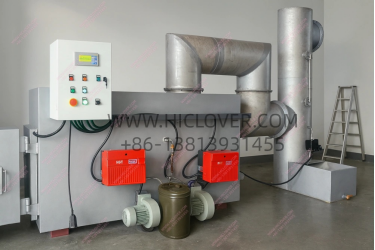
Robust two-chamber combustion (primary + secondary) for safer destruction of medical waste and reduced visible smoke.
-
Simple loading and simple controls to reduce training burden.
-
Optional gas treatment modules chosen by site reality: dry neutralization for acid gases; wet scrubbing only where water supply and drainage are reliable.
-
Containerized or mobile integration where site security/logistics benefit from a protected, transport-ready system.
6) Role of the United Nations and international agencies in shaping procurement
In CAR, international actors are not only “buyers”—they shape technical expectations and procurement patterns:
-
MINUSCA has directly referenced operational distribution of portable incinerators to reduce risks at remote bases, reinforcing an ongoing requirement for field-ready units.
-
UN field-mission waste planning guidance includes explicit sections on incineration procedures, medical waste handling, and ash disposal, which often becomes the template language copied into tenders and RFQs.
-
Development and donor programs in Bangui influence “city-scale” thinking (collection, sanitation services, treatment), which can push more structured waste flows—creating clearer demand segmentation between municipal MSW and medical/special waste.
7) Recommended positioning theme (spotlight): Remote-base biosecurity in CAR
A practical theme to emphasize in CAR is biosecurity in remote operations: in places far from Bangui, including areas around Bria, Bambari, or Bossangoa, the real challenge is not “waste theory,” but how to destroy risk quickly and consistently. Portable, containerized, and rugged incineration systems align with this reality—especially for clinic waste, sharps, and contaminated materials generated by mobile health activities and field bases.
8) HICLOVER positioning for CAR (embedded promotion)
HICLOVER can align well with CAR’s field-driven procurement needs by highlighting durability, deployability, and practical combustion design:
-
Containerized / mobile deployment: rapid shipment, protected installation, simplified site work.
-
Two-chamber combustion + reliable burners: stable high-temperature operation for biomedical waste reduction.
-
Flexible gas-treatment options: match to project constraints (dry systems for simpler sites; wet systems only where utilities allow).
-
Operator-friendly workflows: straightforward loading and clear operating steps—important for staff turnover in remote CAR locations.
Internal links (HICLOVER only; no third-party links):
-
Medical waste incinerator: https://www.hiclover.com/
-
Containerized incinerator: https://www.hiclover.com/incinerator/
-
Mobile incinerator solution: https://www.hiclover.com/
-
Top-loading incinerator: https://www.hiclover.com/incinerator/
-
Incinerator for humanitarian camps: https://www.hiclover.com/incinerator/
9) Practical buyer checklist for projects in Bangui, Berbérati, Bambari, and Bria
-
Waste type definition: medical-only vs mixed waste vs special waste.
-
Throughput target: daily peak volumes (campaign days, vaccination drives, emergency surges).
-
Fuel and utilities: diesel availability, generator stability, water availability (if considering wet scrubbing).
-
Operator plan: training time, turnover risk, maintenance responsibility.
-
Compliance and reporting: UN/NGO documentation needs (O&M manual, commissioning checklist, spare parts list).
Résumé bref (Français)
En République centrafricaine (RCA), la demande d’incinérateurs est surtout portée par Bangui et par les opérations en zones éloignées (Berbérati, Bambari, Bria, Bossangoa), où la collecte et le traitement conformes restent limités. Les acteurs ONU (MINUSCA) et les agences humanitaires jouent un rôle clé en fixant les exigences (déchets biomédicaux, procédures, sécurité). Les solutions les plus adaptées sont robustes, faciles à exploiter, déployables rapidement, avec des options de traitement des fumées selon les contraintes du site.
2025-12-12/10:54:23
|
Incinerator Items/Model |
HICLOVER TS100(PLC)
|
|
Burn Rate (Average) |
100kg/hour |
|
Feed Capacity(Average) |
150kg/feeding |
|
Control Mode |
PLC Automatic |
|
Intelligent Sensor |
Continuously Feeding with Worker Protection |
|
High Temperature Retention(HTR) |
Yes (Adjustable) |
|
Intelligent Save Fuel Function |
Yes |
|
Primary Combustion Chamber |
1200Liters(1.2m3) |
|
Internal Dimensions |
120x100x100cm |
|
Secondary Chamber |
600L |
|
Smoke Filter Chamber |
Yes |
|
Feed Mode |
Manual |
|
Burner Type |
Italy Brand |
|
Temperature Monitor |
Yes |
|
Temperature Thermometer |
Corundum Probe Tube, 1400℃Rate. |
|
Temperature Protection |
Yes |
|
Automatic Cooling |
Yes |
|
Automatic False Alarm |
Yes |
|
Automatic Protection Operator(APO) |
Yes |
|
Time Setting |
Yes |
|
Progress Display Bar |
3.7 in” LCD Screen |
|
Oil Tank |
200L |
|
Chimney Type |
Stainless Steel 304 |
|
1st. Chamber Temperature |
800℃–1000℃ |
|
2nd. Chamber Temperature |
1000℃-1300℃ |
|
Residency Time |
2.0 Sec. |
|
Gross Weight |
7000kg |
|
External Dimensions |
270x170x190cm(Incinerator Main Body) |
|
Burner operation |
Automatic On/Off |
|
Dry Scrubber |
Optional |
|
Wet Scrubber |
Optional |
|
Top Loading Door |
Optional |
|
Asbestos Mercury Material |
None |
|
Heat Heart Technology(HHT) |
Optional |
|
Dual Fuel Type(Oil&Gas) |
Optional |
|
Dual Control Mode(Manual/Automatic) |
Optional |
|
Temperature Record |
Optional |
|
Enhanced Temperature Thermometer |
Optional |
|
Incinerator Operator PPE Kits |
Optional |
|
Backup Spare Parts Kits |
Optional |
|
Mobile Type |
Optional:Containerized/Trailer/Sledge Optional |